In a world where machines can pump out flawless glassware by the thousands, true crystal stands apart-not because it’s flashy, but because it refuses to be rushed. While automation celebrates speed, the finest crystal leans into slowness: each piece shaped by breath, refined by hand, and perfected over hours. The result? Objects that carry weight-both literal and emotional. What exactly justifies this craftsmanship premium?
The artisanal mastery behind every piece
Mouth-blown and hand-cut techniques
Every piece begins not in a mold, but in a flame. The process starts with molten crystal gathered at the end of a long blowpipe. An artisan inflates it slowly, using only controlled breath-never compressed air-to shape the base form. This ismouth-blown crystal, a technique as fragile as it is unforgiving. Too much pressure, and the wall thins unevenly. Too little, and the shape collapses. There’s no room for error.
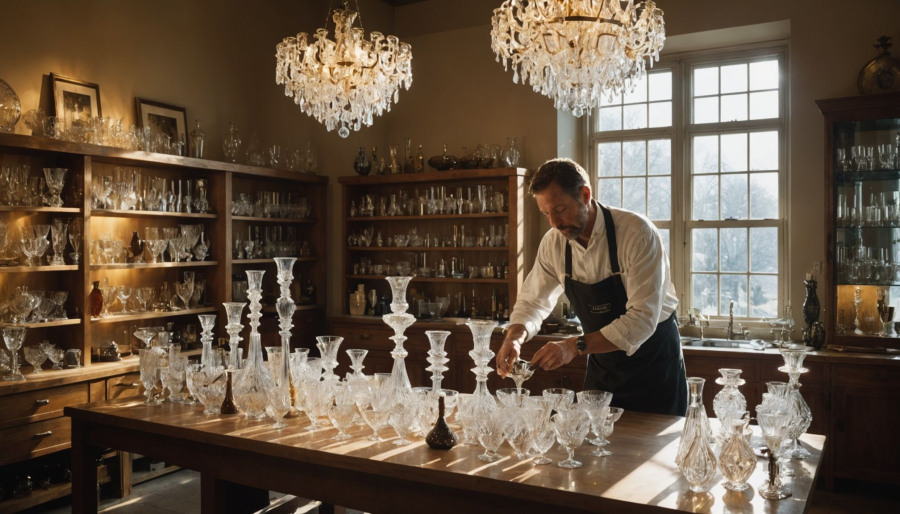
Once set, the piece moves through a succession of hands. One artisan cuts, another engraves, a third polishes. A single wine glass might pass through over a dozen specialists before completion. This layered expertise is where cost begins to accumulate. And this commitment to excellence is precisely what characterizes a manufacturer like Maison Saint Louis.
The high cost of apprenticeship
Mastering these gestures takes time-often more than a decade. The physical toll is real: heat, precision, repetition. Few young people enter the trade, and those who do face years of unpaid refinement before they’re trusted with a signature piece. This scarcity of skill inflates labor value, not by choice, but by necessity. In this sense, every crystal object isn’t just paying for materials-it’s subsidizing the survival of an endangered craft.
Chemical composition: Rare minerals and lead oxide
Dense materials for unique properties
Crystal isn’t just glass with a fancier name. True crystal contains added minerals-traditionally lead oxide, though modern variants use barium or zinc. These elements increase the material’s density, giving it a distinctive heft and brilliance. Sand, soda, and limestone form standard glass. But crystal demands purer, costlier ingredients-materials that affect both clarity and refractive behavior.
Lead oxide, in particular, allows for thinner walls without sacrificing strength. That’s why a fine crystal flute feels delicate in the hand, yet rings with resilience. And while lead-free alternatives exist, they often require more complex formulations to match the optical qualities of traditional leaded crystal.
Obtaining the perfect refraction
Light behaves differently in crystal. Because of its higher refractive index, it bends and splits light more dramatically than glass. Under a chandelier or candle, this creates the prized rainbow effect: tiny prisms of color dancing across a table. It’s not just decorative-it’s a testament to molecular precision. The more uniform the crystal structure, the cleaner the light transmission. This isn’t something mass production can replicate on demand.
Production challenges and the rejection rate
Zero tolerance for imperfections
In luxury crystal, perfection isn’t an objective-it’s the baseline. Even the smallest flaw-a micro-bubble, a faint scratch, a clouded edge-means the piece is destroyed. This isn’t waste; it’s discipline. The rejection rate in high-end ateliers can exceed 30% on complex pieces, especially those with deep cuts or intricate stems.
Consider the cooling process alone: if the temperature drops too quickly, internal stress fractures form. Too slowly, and the schedule becomes untenable. This balance-called annealing-requires precise control over days. Other factors that impact yield include:
- Purity of the initial melt-any contamination ruins clarity
- Precision in cooling time-measured in hours, not minutes
- Complexity of manual engraving-each cut multiplies risk
- Final polishing stages-where invisible flaws surface
Traditional glass vs. Crystal: A performance comparison
Durability and thinness
Contrary to myth, fine crystal isn’t fragile-it’s engineered to be thin yet resilient. A masterfully blown crystal glass can be astonishingly delicate in feel, yet withstand decades of use. Cheap glass, by contrast, often compensates for brittleness with thickness. You feel the difference immediately: bulk versus balance. Sommeliers and collectors alike prize this subtle strength because it enhances the tasting experience-the rim is thinner, the weight more harmonious.
Aural qualities and vibration
Tap a crystal glass with a fingernail, and it sings. That sustained, clear ring-known as the crystal resonance-is a hallmark of quality. Glass, on the other hand, produces a dull clink. The mineral structure allows vibrations to travel longer, cleaner paths. This acoustic quality isn’t just pleasing; it’s diagnostic. Experts often use it to verify authenticity. No amount of surface shine can fake that tone.
Economic landscape of the crystal market
The price gap between ordinary glass and true crystal isn’t arbitrary-it reflects tangible differences in process, skill, and materials. The table below illustrates how value scales with craftsmanship.
| Production Method | Material Cost | Labor Intensity | Typical Price Bracket |
|---|---|---|---|
| Mass-produced Glass | Low (sand-based) | Minimal (automated) | 5-15 per glass |
| Mid-range Crystal | Moderate (lead-free mix) | Partial automation | 20-60 per glass |
| Luxury Hand-cut Crystal | High (lead oxide, pure melt) | Extensive (entirely manual) | 100-500+ per glass |
Investment value and heritage transmission
Crystal as a family heirloom
Unlike disposable design, fine crystal is made to outlast its owner. Properly cared for, a single piece can endure for generations. Think of it less as dinnerware and more as a legacy object-something passed down with stories attached. This longevity is part of its value. Families often acquire crystal for milestones, not convenience. The act of gifting it carries weight, not just because of price, but because it implies continuity.
The secondary market and collectibility
Certain pieces, particularly those from renowned houses or limited editions, gain value over time. Signed vases, chandeliers, or original designs can command higher prices at auction. This isn’t guaranteed appreciation, but it reflects a shift in perception: crystal as art, not just function. When you buy from a legacy atelier, you’re not just purchasing a glass-you’re joining a lineage. For many, that’s worth more than the material cost.
Common Questions
Is it safe to use lead crystal for daily dining?
Most modern lead crystal is safe for occasional use, as the lead is locked within a stable mineral matrix. However, long-term storage of acidic liquids (like wine or juice) can leach trace amounts. Many collectors reserve leaded pieces for display or short-term use. Lead-free crystal, now widely available, offers the same brilliance without the concern-making it a practical choice for daily dining.
How does handmade crystal compare to Swarovski machine-cut pieces?
Handmade crystal carries a unique irregularity-micro-ripples in the wall, slight asymmetry in cuts-that machine precision eliminates. Swarovski excels in consistency and sharpness, ideal for jewelry or decor. But handmade pieces offer soul over symmetry. The difference is like comparing a printed poem to a handwritten letter-one is flawless, the other feels lived-in.
What is the first thing I should do if my crystal gets cloudy after years of use?
Cloudiness usually comes from mineral deposits or detergent residue. Try soaking the piece in warm water mixed with white vinegar for 15-20 minutes, then scrub gently with a soft brush. Avoid abrasive pads. If the haze persists, it may be surface pitting-permanent wear from dishwasher use. For valuable sets, professional restoration is often worth considering.
When is the best time to invest in a full crystal set?
Many choose milestone moments: a wedding, a new home, or a significant anniversary. These occasions align with the symbolic weight of crystal as a lasting object. Buying as a set also ensures uniformity in pattern and cut. But there’s no “wrong” time-some start with a single piece and build over years. The key is intention: this isn’t decor, it’s heirloom-building.
